UNIQ x UAAT 2026
June 16-18, 2026
National Taiwan University, Taipei, Taiwan.
National Taiwan University, Taipei, Taiwan.
| Home | Registration | Program | Directions | Accommodation |
|
| June 16 | June 17 | June 18 |
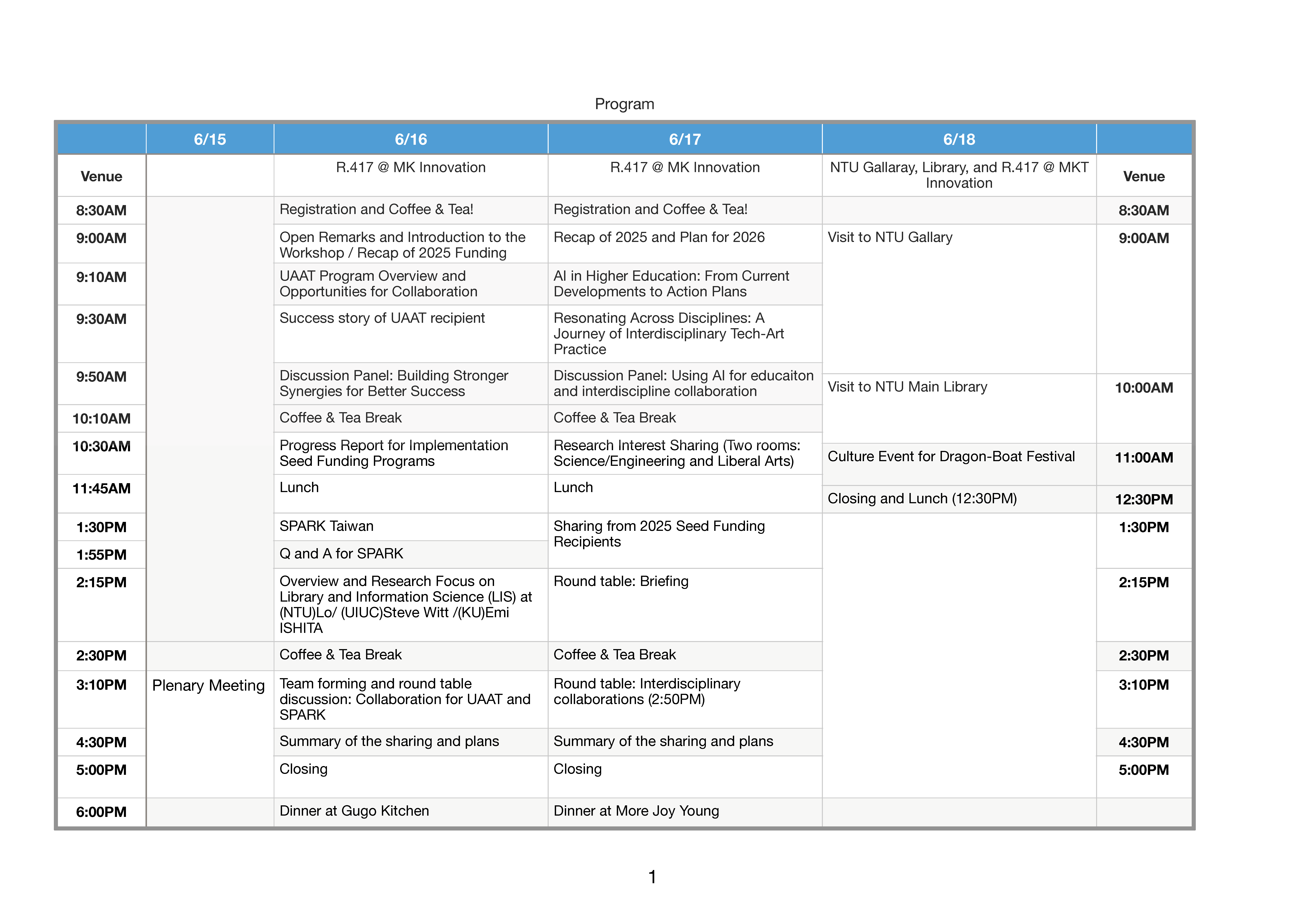
| 8:30am | Registration and Coffee & Tea! |
| Location: R417 of MKT Innovation Building |
| 9:00am | Open Remarks and Introduction to the Workshop |
| Prof. Chi-Sheng Shih (National Taiwan University) |
| 9:10am | UAAT Program Overview and Opportunities for Collaboration |
| Prof. Ya-Ping Chiu, Distinguished Professor and Deputy Vice President, Office of Research and Development, National Taiwan University. | |
| This talk will provide an overview of the UAAT program, highlighting its goals, structure, and the various opportunities it offers for collaboration among the member institutions. Attendees will learn about the resources available through UAAT, including funding opportunities, joint research initiatives, and student exchange programs. The talk will also discuss how researchers can leverage UAAT to enhance their research impact and build stronger synergies with their counterparts at UIUC and KU. |
| 09:30am | Success story of UAAT recipient |
| Prof. Chao-Hsin Wu, Director and Professor, GIEE, National Taiwan University. | |
| Prof. Wu and his team recevied the 2025 UAAT seed funding for their project. In this talk, Prof. Wu will share the journey of their project, from the initial proposal stage to the successful implementation and outcomes. He will discuss the challenges they faced, how they overcame them, and the impact of their research on sustainable agriculture practices. This talk will provide valuable insights for attendees who are interested in applying for the 2026 seed funding program and want to learn from a successful UAAT recipient. |
| 09:50am | Discussion Panel: Building Stronger Synergies for Better Success |
| Prof. Chi-Sheng Shih (National Taiwan University), Prof. Ya-Ping Chiu (National Taiwan University), and Prof. Chao-Hsin Wu (National Taiwan University) | |
| In this panel discussion, the speakers will engage in a conversation about how to build stronger synergies for better success in collaborative research. They will share their perspectives on the importance of collaboration, the challenges that can arise, and strategies for overcoming those challenges. The panel will also discuss how programs like UAAT can facilitate stronger collaborations and enhance research outcomes. Attendees will have the opportunity to ask questions and participate in the discussion. |
| 10:10am | Coffee & Tea Break |
| 10:30am | Progress Report for Implementation Grant Programs |
| Recipients of 2025 Implementation Funding Programs (Four): Prof. Huang, Prof. Wu, Prof. Chang, and Prof. Cheng (15 mins for each project.) | |
| In this plenary session, recipients of the short-term seed funding will present progress reports on their projects. Each recipient will share updates on their research activities, preliminary results, and any challenges they have encountered. This session will provide an opportunity for attendees to learn about the ongoing research efforts funded by the seed program and to gain insights into the potential impact of these projects. The plenary format allows for a more in-depth presentation and discussion of each project, fostering a deeper understanding of the research being conducted under the UAAT program. |
| 11:45am | Group Photo and Lunch |
| Location: Pin Xuan Chinese Restaurant (2F, LiXian Hall) Direction: Map |
| 1:30pm | SPARK |
| Prof. Yufeng Jane Tseng | |
| SPARK TAIWAN Program is a collaboration with Stanford University, the cradle of biotechnology industry development in the United States, to link the Stanford SPARK Program training model and resources. Through regional anchor universities with biomedical interpretation capabilities, this program builds a biomedical talent training environment that meets the local needs of Taiwan. In addition to providing key training courses in translational R&D, clinical-need assessment, medical regulation issues, intellectual property and negotiation, marketing, and commercialization planning along the product value chain, the program is complemented by an industry expert panel with practical experience in the biotechnology field, and the development of each anchor university's unique translational training model. |
| 1:55pm | Panel: |
| Prof. Yufeng Jane Tseng | |
| (Abstract) |
| 2:15pm | Overview and Research Focus on Library and Information Science (LIS) at NTU, UIUC, and KU. |
|
Prof. Szu-Chia Lo, Director of Department of Library and Information Science, National Taiwan University Prof. Steve Witt, Professor, Director of the Center for Global Studies, and Head of the International and Area Studies Library at the University of Illinois Urbana-Champaign Prof. Emi ISHITA, Professor of the Department of Library Science, Kyushu University |
|
| (Overview and Research Focus of the department) |
| 2:50pm | Coffee & Tea Break |
| 3:10pm | Team forming and round table discussion: Collaboration for UAAT and SPARK Taiwan |
| All participants | |
| (Abstract) |
| 4:30pm | Discussion report and sharing |
| All participants | |
| (Abstract) |
| 5:00pm | Closing and Summary |
| All participants | |
| (Abstract) |
| 06:00pm | Dinner |
| Location: Gugo Kitchen Restaurant Direction: Map |
| June 16 | June 17 | June 18 |
| 8:30am | Registration and Coffee & Tea! |
| Location: R417 of MKT Innovation Building |
| 09:00am | Recap of 2025 Funding Programs |
| Daniel Shih, Sammer Jones, and Natalie Konomi | |
| (Review process and Criteria of 2025 program) |
| 9:10am | AI in Higher Education: From Current Developments to Action Plans |
| Prof. Hsin-Mu Tsai, Deputy Vice President for Academic Affairs/Director, Center for Teaching and Learning Development, Digital Learning Center, and Academic Advising Office, National Taiwan University | |
|
Artificial intelligence is already transforming higher education, not as a distant future concern but as an immediate reality: evidence increasingly shows that AI tools have become part of students’ everyday learning activities. This talk examines the rapid development of AI capabilities and discusses what these changes mean for universities, teachers, and students. Drawing on classroom observations, educational research, and practical examples, it explores the risks of unguided AI use, the importance of preserving meaningful learning processes, and the broader challenge of preparing students for an AI-integrated future. The talk further discusses how AI models are trained, why domain expertise and localized knowledge remain essential, and how students should be prepared not only to use AI tools but also to evaluate, supervise, and contribute to AI systems. As AI begins to replace some entry-level tasks while expanding opportunities for human-AI collaboration, higher education must rethink how it cultivates students’ foundational abilities, professional judgment, and capacity to work with AI. The goal is to move from current developments to concrete action plans for teaching and learning in the AI era. |
| 9:35am | Resonating Across Disciplines: A Journey of Interdisciplinary Tech-Art Practice |
| Prof. Hsiao-Mei Hsieh, Associate Professor, Department of Drama and Theatre, National Taiwan University | |
|
How can we bridge the gap between advanced engineering capabilities and high-impact human experiences? This presentation shares the execution of Hamlet Machineman, a two-year experimental telematic performance project led by National Taiwan University (NTU). Designed as a model for multi-institutional and cross-disciplinary synergy, this initiative demonstrates how theatrical narrative can serve as a robust testbed for emerging technologies. Funded by Ministry of Culture under the 5G Action Plan, the first year focused on cross-departmental curriculum testing to foster interdisciplinary talents. In its second year, it transitioned into a large-scale formal production, staging five public ticketed performances simultaneously synchronized across two physical campus venues. Rather than treating technology as a mere tool, the project integrated hardware directly into the narrative core: an industrial robotic arm and screen interfaces were deployed as physical embodiments of psychological distance and surveillance. We will discuss the conceptual and operational milestones of managing this complex, dual-site multi-modal collaboration. Finally, the presentation will conclude by proposing that the ultimate value of tech-art collaboration lies in leveraging robust engineering to amplify uniquely human faculties—creating a future where technology and human experience elevate one another. |
| 9:55am | Panel: AI at Higher Education |
| Prof. Hsin-Mu Tsai, Prof. Hsiao-Mei Hsieh, and Prof. Chi-Sheng Shih |
| 10:15am | Coffee & Tea Break |
| 10:30am | Research Outcomes/Plan Sharing (Two rooms: Science/Engineering and Liberal Arts) |
| Participants of the 2nd day Program (10 mins for each talk) | |
| (Abstract) |
| 12:00pm | Group Photo and Lunch |
| Location: MD Cuisine Direction: Map |
| 1:30pm | Sharing from 2025 Initiation and Teaching/Learning Grant Recipients |
| Three recipients of 2025 Initiation and Teaching/Learning Grants: Prof. Lin, Prof. Huang, and Prof. Liu (15 mins for each) | |
| (Abstract) |
| 2:20pm | Summary of the sharing and plans |
| Representative for each group or teams | |
| (Abstract) |
| 2:50pm | Coffee & Tea Break |
| 3:10pm | Round table: Interdisciplinary collaboration |
| Participants of the 2nd day Program |
| 4:15pm | Summary of the sharing and plans |
| Representative for each group or team |
| 5:00pm | Closing and Summary for 2nd day |
| Daniel Shih, Sammer Jones, and Natalie Konomi |
| 06:00pm | Dinner |
| Location: More Joy Young - Sophisticated Mutton Dishes Direction: Map |
| June 16 | June 17 | June 18 |
| 9:00am | Visit to the National Taiwan University History Gallery |
| Location: National Taiwan University History Gallery Direction: Map | |
| National Taiwan University, founded in 1928 as Taihoku Imperial University, was Taiwan's only university during the Japanese colonial period. After World War II, it was reorganized as National Taiwan University in November 1945. In May 2004, President Chen Wei-chao initiated a museum-scale history exhibition to showcase NTU's role in Taiwan's social development. The permanent exhibition occupies the central reading hall of the Old Main Library, built in 1929. When the library relocated in 1998, this designated historic site became home to the Drama Department's theater and, later, the History Gallery. After a year of preparation, President Chen presided over the opening on June 22, 2005. The gallery officially welcomed visitors with guided tours on November 7. In 2007, alumnus Mr. Lee Hwa-lin's Chuan Lyu Foundation funded the special exhibition hall. Named "Chuan Lyu Exhibition Hall" to honor his dedication, it opened on University Anniversary Day (November 15) with the "NTU Museums Special Exhibition." The permanent exhibition spans 750 square meters, with the Chuan Lyu Hall covering 300 square meters. Beyond exhibitions and tours, the History Gallery collects artifacts and preserves NTU's tangible and intangible heritage. |
| 10:00am | Visit to the National Taiwan University Main Library |
| Location: National Taiwan University Main Library Direction: Map | |
| National Taiwan University (NTU) now occupies the site of what was once the Taihoku Imperial University, established in March of 1928 by the resident Japanese. In the same year the Taihoku Imperial University Library was built to support academic research. With the restoration of Chinese rule in 1945, Taihoku Imperial University was handed over to the Republic of China and the university was renamed National Taiwan University. The NTU Library as it is today was officially opened to the public in November 1998 after 12 years of planning and construction. The new building was designed by Haigo Shen & Partners in the spirit of the original building: robust, symmetrical and retaining the arched windows, gable ends and piazza, the 35,000 square-meter library, with its solid rosewood furniture, designed by the same company, provides a sanctuary for study. The Library has integrated most of the university’s previously dispersed departmental libraries and is now able to provide a comprehensive academic library service. NTU’s scholars can expect longer open hours, extended loan periods, a centralized and expanding collection, increased electronic resources, the first-ever Automated Storage and Retrieval System (ASRS) officially enabled in October 2018, and digitized projects from our special collections and art exhibitions . |
| 11:00am | Culture Event for Dragon-Boat Festival |
| Location: R417 at MK Innovation Building, National Taiwan University Direction: Map | |
| With the Dragon Boat Festival approaching, do you also hang amulets at your door, carry sachets, and bathe with plants like mugwort and lemongrass? This year, our team at the Agricultural Research Station will introduce you to plants associated with the Dragon Boat Festival. We’ll guide you in making sachets using specially blended aromatic powders and creating your own DIY amulets. Through the magical fragrance of these plants, we hope to bring you peace and blessings for your body, mind, and spirit as we welcome the summer season. |
| 12:30pm | Lunch and Closing |
| June 16 | June 17 | June 18 |